Research Article / Quantitative Frontier

Prediction,
under a microscope.

Abstract— This article describes a reproducible tabular-regression workflow in which data audit, feature construction, model comparison, cross-validation, and residual analysis remain connected. The framework treats predictive modelling as a sequence of inspectable methodological choices. Its purpose is to make model behaviour legible: not merely to estimate a target, but to identify the representation and validation decisions that support or limit an estimate.

TABULAR REGRESSIONFEATURE ENGINEERINGCROSS-VALIDATIONRESIDUAL DIAGNOSTICSREPRODUCIBILITY
4Analytical stages
3Model families
K-foldValidation protocol
Scope statement: the figures are original scientific explanatory diagrams. This article presents a reproducible research framework and does not claim an external benchmark score, production forecast, or causal conclusion.
Audit–feature–fit workflow for a tabular prediction study
Figure 1. Audit–feature–fit workflow for a tabular prediction study
1. Introduction and Study Scope

Prediction must remain
open to inspection.

This article expands the portfolio’s tabular-regression module into a research-paper format. The emphasis is not a leaderboard position; it is the chain of decisions that allows a prediction to be challenged, compared, and revised.

Research question

How can a housing-price regression study preserve enough methodological structure for readers to understand what the model learned, where it failed, and why a later revision should be trusted?

  • 01Representation. Translate raw numeric and categorical fields into an auditable feature space without hiding the origin of a transformed variable.
  • 02Comparison. Contrast transparent baselines, regularised variants, and more flexible learners as different analytical lenses.
  • 03Diagnosis. Use validation and residual slices to determine whether an apparent gain is stable and explainable.
Study boundary: this is a generic House Prices-style research workflow. It does not report a Kaggle ranking or support appraisal, lending, or automated decision-making.
Research protocol

audit → define → test → review
01

Audit the table

Inspect field type, completeness, duplicate records, skewness, and influential observations before fitting.

AUDIT
02

Construct features

Encode categories and record all transformations so each model input can be related back to a source field.

FEATURES
03

Validate by folds

Use repeated or K-fold validation to separate model selection from performance description.

VALIDATE
04

Review residuals

Map errors to data conditions before proposing a model revision.

DIAGNOSE
2. Data Audit and Feature Construction

The feature space is
a methodological claim.

Feature engineering is treated as structured representation work. Its purpose is to make a model responsive to relevant variation while preserving a readable account of how original observations were transformed.

Audit-to-inference protocol

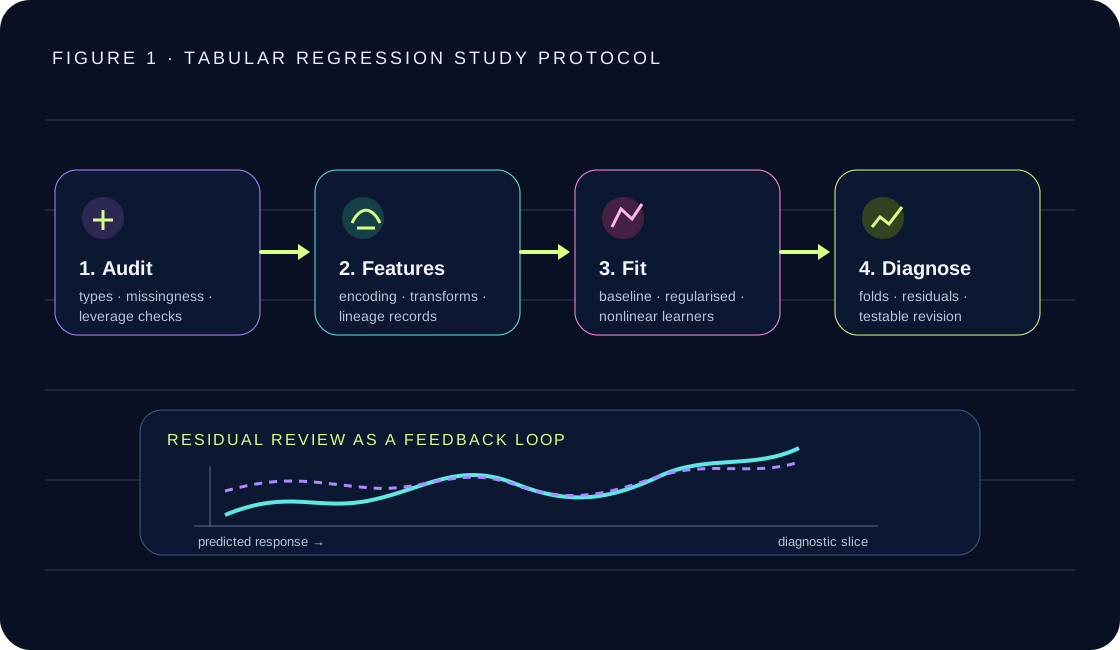
Figure 2 formalises the workflow from raw-table inspection to residual review. Each stage leaves an artefact that can be examined: data rules, feature definitions, model specifications, fold assignments, and diagnostic slices.

A scientific workflow connecting data audit, feature construction, model fitting, validation, and residual review.
Figure. A scientific workflow connecting data audit, feature construction, model fitting, validation, and residual review.

Feature-construction principles

Useful features need not be numerous, but they must be declared. A feature record should specify source columns, transformation logic, missing-value treatment, scale, and whether it was fitted only on training folds.

  • AType awareness. Numeric, ordinal, nominal, date-like, and free-text fields are not interchangeable; encoding should reflect measurement meaning.
  • BDistribution awareness. Skewed quantities, extreme values, and sparse categories require inspection before a transform becomes routine.
  • CFold isolation. Imputation, scaling, and target-informed decisions are fitted on training partitions and applied to held-out observations.
Interpretive rule: a transformed feature is not automatically an explanatory variable. It remains an input representation whose behaviour must be tested and contextualised.
3. Model Comparison and Validation

A score is a clue,
not a conclusion.

Cross-validation estimates the stability of a modelling procedure under repeated partitioning. It should be accompanied by a description of dispersion, error slices, and the assumptions that distinguish one model family from another.

Comparative modelling roles

The study compares families because they expose different properties of the data. A linear baseline makes direct relationships visible; regularisation tests whether the feature space is disciplined; nonlinear learners explore interaction and threshold structure.

  • ILinear baseline. Establishes an interpretable reference and reveals obvious coding, scaling, or structural problems.
  • IIRegularised regression. Tests sparse or shrinkage-oriented representations when many candidate features compete for inclusion.
  • IIIGradient boosting. Explores nonlinear relations and interactions while increasing the need for diagnostic discipline.
Reporting convention: model families are presented by their analytical role. This page intentionally does not provide numerical performance claims.

Fold-wise evaluation and error strata

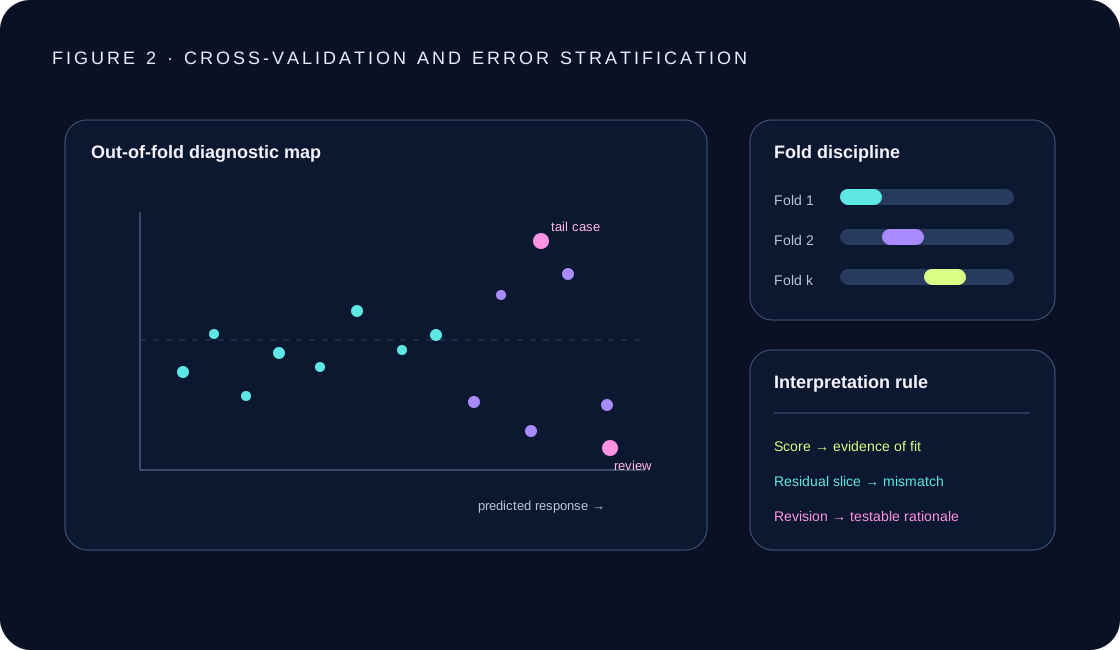
Figure 3 shows why a pooled score should be supplemented with out-of-fold residual patterns. Highlighted points represent observations requiring review because error is concentrated in an identifiable data condition.

Cross-validation folds and an out-of-fold residual plot showing highlighted cases for review.
Figure. Cross-validation folds and an out-of-fold residual plot showing highlighted cases for review.
4. Residual Diagnostics and Interpretability

Error carries the next
research question.

Residual analysis changes the conversation from “Which model wins?” to “Under what conditions does the representation fail?” That shift supports improvements that can be justified as hypotheses rather than indiscriminate tuning.

Diagnosing structured error

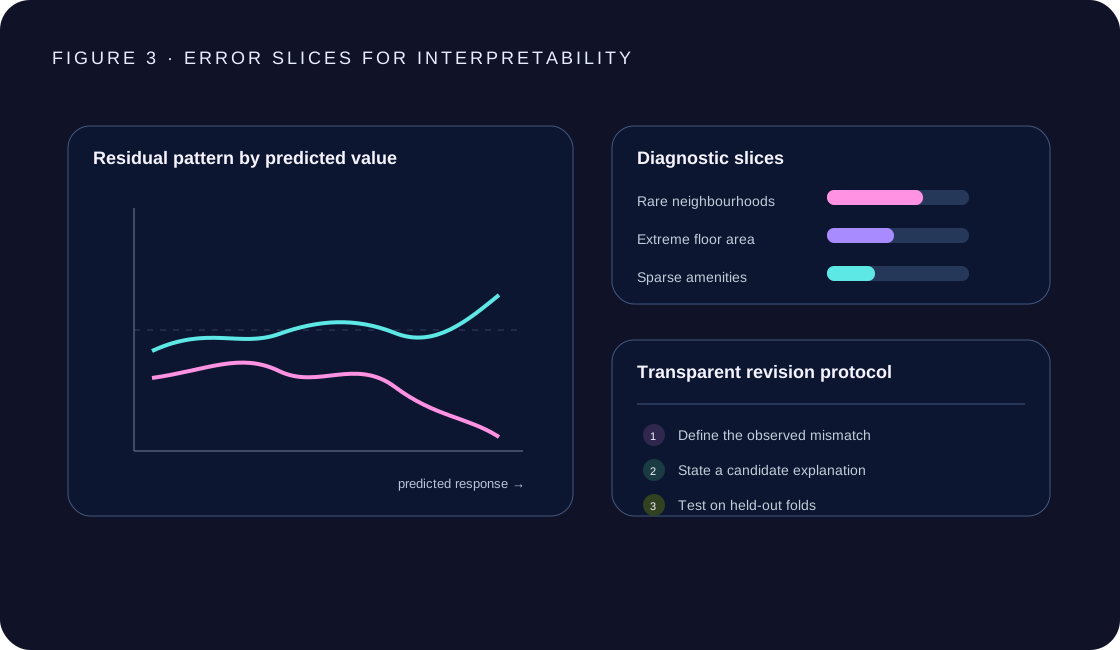
Residuals are reviewed across predicted-value ranges and meaningful subgroups. The purpose is to distinguish random noise from patterns associated with sparse locations, unusual configurations, or boundary cases.

Residual pattern plot and diagnostic slices for transparent model revision.
Figure. Residual pattern plot and diagnostic slices for transparent model revision.

Transparent revision loop

A revision is stronger when it follows a named mismatch. An error cluster may motivate a hypothesis about an unrepresented interaction, a sparse-category strategy, or a data-quality issue. The candidate change is then evaluated under the same fold protocol.

  • 01Locate. Identify whether error is concentrated by response range, subgroup, missingness pattern, or temporal segment.
  • 02Explain. Formulate a candidate reason consistent with the data-generating context and current representation.
  • 03Test. Apply one controlled change, retain the prior version, and compare fold-wise behaviour rather than only an aggregate statistic.
Ethical caution: predictive systems can encode historical inequalities or measurement gaps. Error analysis should include fairness and coverage questions whenever outputs affect people or resources.
5. Discussion, Limitations, and Conclusion

A prediction should retain
its reasoning trail.

The contribution of this module is methodological. It joins analytical evidence with the conditions necessary for its responsible interpretation and communication.

P

Prediction becomes more credible when the path from observation to error is visible. The framework recommends retaining preprocessing rules, feature definitions, model configurations, fold assignments, diagnostic views, and revision rationale as connected research artefacts.

The recommended practice is to retain data lineage, modelling or harmonisation decisions, uncertainty statements, visual mappings, and revision rationale as connected research artefacts.

Limitations: the figures and examples on this page are conceptual explanatory material. They do not report validated prediction accuracy, an ecological estimate, or an empirical causal effect. Applied use requires context-specific data governance, validation, and specialist review.

Article components

01

Data audit record

Documents field types, quality checks, missingness treatment, and eligibility conditions before a model is fitted.

DATA
02

Feature and model specifications

Preserve transformation rules, model-family decisions, and versioned assumptions for comparison.

METHOD
03

Validation and diagnostic evidence

Connect held-out performance with residual slices and the rationale for subsequent revision.

REVIEW