Research Paper / System 01 · Version 1.0

Parametric Statistical
Modelling and Dynamic Rendering.

Abstract— This research system formalises an end-to-end workflow for statistical modelling in which data provenance, parameter definitions, execution states, and visual outputs remain explicitly connected. The proposed design integrates heterogeneous data access, configurable model specifications, asynchronous task scheduling, dynamic rendering templates, and operation-level audit records. The objective is not to replace methodological judgement with visual output, but to support traceable analysis in which every rendered view can be associated with a defined input scope, a model version, and an execution record.

PARAMETRIC MODELLINGDATA PROVENANCEDYNAMIC VISUALISATIONREPRODUCIBILITY
5,266Documented Source Lines
4Data–Model–Task–Render Layers
2Deployment Modes: SaaS / Private
Scope statement: this page is an academic-style description of the documented software design. It does not report benchmark performance or use production data.
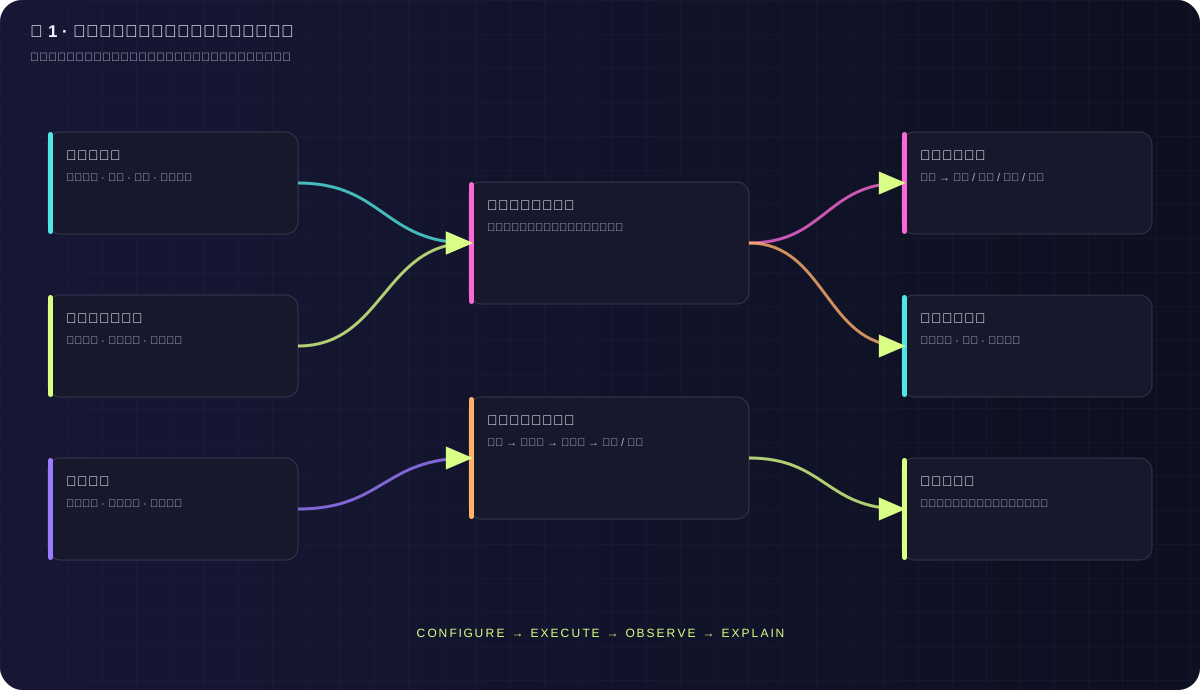
Architecture diagram for a parametric statistical modelling and rendering workflow
Figure 1Traceability-Oriented Research Workflow
1. Introduction and Research Scope

A model is not
only an equation.

In applied statistical work, an analytical result is meaningful only when its data context, model assumptions, parameter values, and computational history can be inspected together. This system therefore treats the model as a research object with a documented lifecycle rather than a detached numerical procedure.

Research problem

Conventional analysis pipelines often separate data access, parameter selection, task execution, and visual reporting into independent tools. That separation makes it difficult to determine whether a chart refers to the intended data snapshot or whether a result was produced under the correct parameter configuration. The present design addresses this discontinuity by retaining links among source connections, variable definitions, versions, task states, and rendering rules.

  • 01Input traceability. Source configuration, connection status, schema preview, and field-level interpretation are preserved before a modelling task is created.
  • 02Specification transparency. Variables, algorithm settings, stopping conditions, and parameter boundaries are represented in a versioned configuration space.
  • 03Output interpretability. Dynamic visual attributes are specified as explicit mappings from model outputs rather than treated as decorative presentation choices.
Research proposition: reproducibility improves when analytical configuration and visual expression are represented as connected, inspectable artefacts.
System boundary and technical setting

The implementation is specified as a web-oriented research platform. The backend is described using Java and Spring Boot; the documented runtime environment includes MySQL, Redis, and Nginx or Tomcat. The rendering layer is designed to use browser-based visualisation technologies, including Three.js and ECharts, to connect statistical indicators with geometric and chart-based representations.

  • AData integration. Configurable adapters support source registration, connection testing, and structural preview before modelling begins.
  • BModel execution. Parameter specifications are transformed into executable tasks that expose queued, running, successful, failed, terminated, published, and archived states.
  • CVisual expression. Rendering templates retain the rule set that maps calculated indicators to visual properties and temporal updates.
Boundary condition: the system organises analytical work and evidence presentation; the validity of any statistical conclusion remains dependent on data quality, model choice, and domain review.
2. Methodological Framework

Parameters become
research evidence.

The methodological premise is that parameterisation should expose, rather than conceal, analytical assumptions. Each configuration is treated as a reproducible experimental condition defined by an input window, a set of variables, a model form, and a governed execution process.

Parameter space and response structure

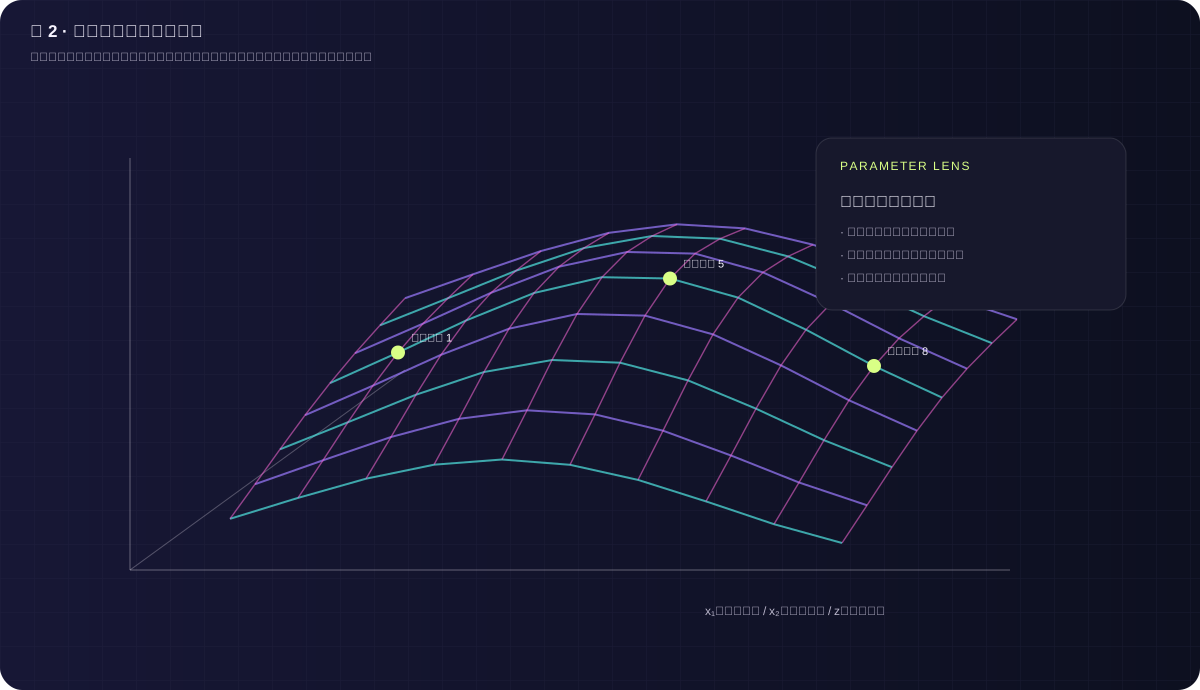
Figure 2 illustrates a generic response surface generated by two configurable dimensions. In practical use, these dimensions may correspond to variable inclusion rules, threshold values, iteration limits, temporal windows, or other study-specific controls. The graphic is schematic and does not represent a measured result.

Schematic parameter space and statistical response surface
Figure 2. A conceptual response surface used to communicate how controlled parameter changes can be linked to observable changes in model output.

Analytical protocol

define → specify → version → execute
01

Define the analytical population

Specify the source connection, fields, sample or temporal window, target quantity, data types, and known data-quality constraints. This establishes a documented input population for the task.

INPUT
02

Declare model form and constraints

Record the algorithm, formula or modelling family, parameter ranges, iteration conditions, validation rules, and stopping criteria before execution.

SPECIFY
03

Register a comparable version

Persist the configuration as a model version so that alternative assumptions can be compared under matched data conditions and a clear change history.

VERSION
04

Submit and observe the task

Translate the configuration into an executable job and retain state transitions, diagnostic logs, and exception information for later inspection.

RUN
3. Dynamic Rendering as Scientific Communication

Visual variables
require semantics.

Dynamic visualisation can improve the readability of high-dimensional model output, but it can also introduce ambiguity if colour, size, motion, or geometry are disconnected from analytical meaning. The rendering layer therefore represents visual encoding as a formal mapping between indicators, rules, thresholds, and temporal indices.

Visual encoding principles

Each graphical element is treated as an analytical statement. A bar height, colour band, point radius, trajectory, or animation state must be connected to a specified indicator and a recorded transformation rule. This structure allows a reader to inspect why an output appears as it does and whether alternative encoding decisions would alter interpretation.

  • ISemantic binding. A visual channel is assigned a defined analytical role, such as magnitude, threshold category, uncertainty flag, or temporal progression.
  • IIRule retention. The template stores the mapping conditions, threshold definitions, and style parameters used to produce the view.
  • IIIProvenance linkage. A rendered output is associated with a data snapshot, model version, task identifier, and execution log.
Interpretive caution: visualisation supports exploration and communication; it does not by itself establish statistical validity or causal inference.

Indicator-to-visual mapping

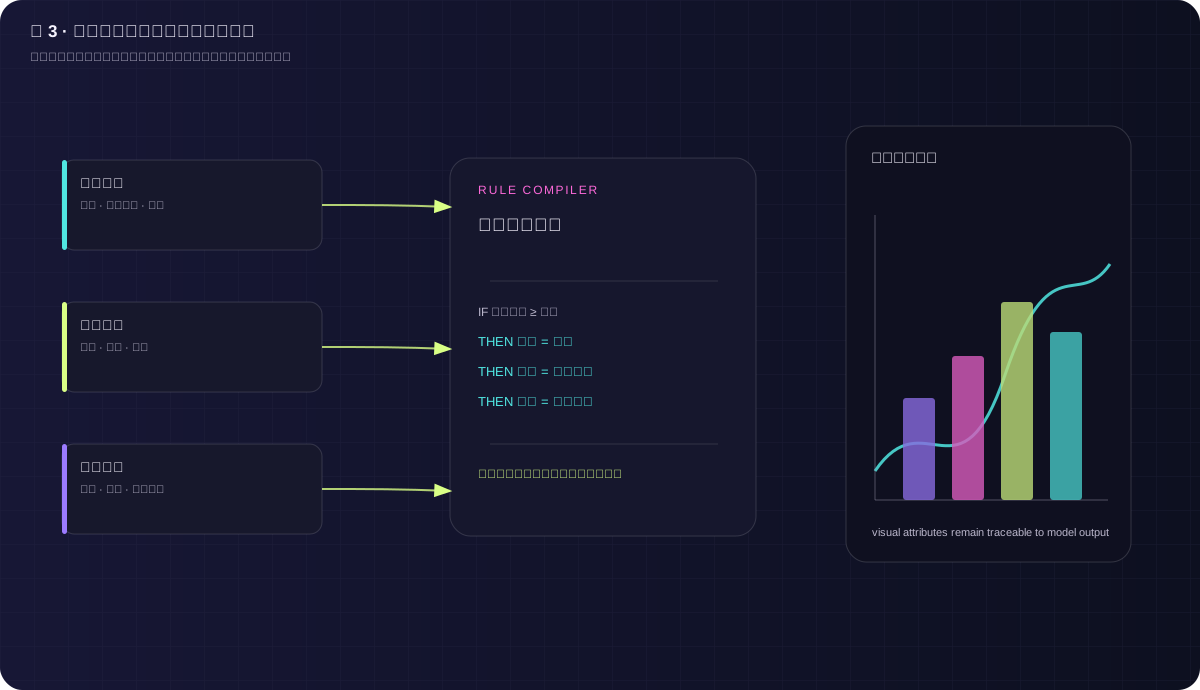
Figure 3 depicts the compilation of analytical indicators, thresholds, and temporal indices into a dynamic evidence view. It is an explanatory systems diagram rather than a performance result.

Conceptual mapping from statistical indicators to dynamic visual attributes
Figure 3. A rule-based pathway linking analytical values to visual attributes while retaining traceability to the modelling process.
4. Execution Assurance and Reproducibility

A run should be
open to inspection.

Reproducibility depends on more than parameter storage. It requires controlled access, governed transitions, persistent logs, and a durable record of the actions that shaped an analytical result. The platform incorporates these operational requirements into the same workflow that produces model output.

01

Authentication and Sessions

Identity verification and token-based sessions establish a controlled access boundary for the web application and its analytical resources.

02

Role-Based Access Control

Administrative, modelling, analytical, and decision-support roles are assigned differentiated permissions to reduce unauthorised configuration changes.

03

State-Machine Governance

Tasks are constrained by defined status transitions, preventing unsupported movement among draft, pending, running, completed, failed, terminated, published, disabled, and archived states.

04

Execution Logging

Task-level messages and exception information create a basis for diagnostic review, repeatability checks, and performance investigation.

05

Operation Audit

Configuration saves, data previews, state changes, exports, and system parameter edits are retained as searchable operational records.

06

Deployment Adaptation

The documented design supports browser delivery and server-side deployment in SaaS or private environments, subject to local infrastructure controls.

5. Discussion, Limitations, and Conclusion

Results need
a lineage.

The contribution of the system is architectural and methodological: it joins modelling configuration, task execution, visual encoding, and governance into a single traceable research workflow. Its value lies in reducing the gap between a calculated output and the conditions under which that output was generated.

PS

A scientific output should preserve both a result and the path by which the result was produced.

When an analyst revisits a visual output, the intended workflow is to recover the source definition, parameter version, execution record, rendering template, and relevant operational history. When an analysis is revised, the revised configuration can be retained as a comparable version rather than overwriting the prior study condition.

Limitations: the figures on this page are original explanatory diagrams. No production dataset, benchmark result, or domain-specific causal claim is presented. Quantitative validation must be conducted separately for each deployment context.

Documented system components referenced by this paper

01

Data Source Integration and Adaptation

Source configuration, connectivity testing, and schema preview establish a governed entry point for data used in modelling.

DATA
02

Statistical Model Configuration and Versioning

Variables, algorithms, parameters, and version comparisons formalise alternative analytical specifications.

MODEL
03

Dynamic Rendering and Task Scheduling

Rendering templates connect indicators to visual rules while scheduled tasks retain execution states and logs.

RENDER

Documentation basis: feature descriptions, deployment specifications, and software architecture records supplied for Version 1.0.