Research Article / Quantitative Frontier

Nature,
made legible.

Abstract— This article presents an evidence-oriented framework for environmental research and public science communication. The proposed workflow connects multi-source observation, data harmonisation, trend and uncertainty analysis, and interactive translation for broader audiences. The objective is to make environmental patterns more understandable without severing them from their measurement conditions, assumptions, or limits of inference.

ENVIRONMENTAL DATAHARMONISATIONTIME SERIESUNCERTAINTYSCIENCE COMMUNICATION
3Evidence streams
2Interpretation layers
1Communication loop
Scope statement: the figures are original scientific explanatory diagrams. This article presents a reproducible research framework and does not claim an external benchmark score, production forecast, or causal conclusion.
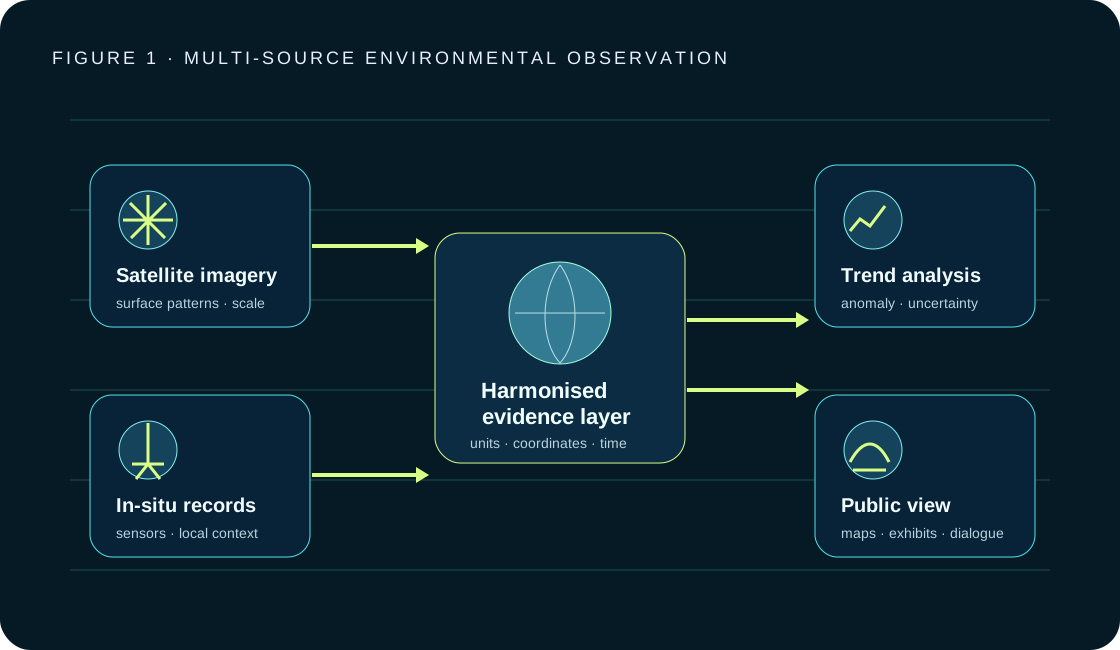
Multi-source environmental evidence architecture
Figure 1. Multi-source environmental evidence architecture
1. Introduction and Research Scope

Environmental systems need
context before clarity.

This article expands the portfolio’s environmental-research module into a structured account of how heterogeneous observations can be transformed into cautious, public-facing scientific evidence.

Research problem

Environmental evidence is often distributed across locations, instruments, time scales, and communities of interpretation. A chart can be visually clear while remaining scientifically incomplete if units, coverage, uncertainty, seasonal structure, or source conditions are omitted.

  • 01Observation. Register what was measured, where, when, at what scale, and with what limitations before harmonisation begins.
  • 02Interpretation. Separate detected patterns from causal claims and carry uncertainty forward into trend and anomaly communication.
  • 03Translation. Design maps, exhibits, and interaction around defined questions so public engagement remains connected to evidence.
Research boundary: this is an explanatory framework for environmental-data interpretation and science communication, not an operational warning system or an assessment of a particular ecosystem.
Evidence protocol

audit → define → test → review
01

Collect observations

Describe spatial reference, temporal cadence, measurement unit, instrument condition, and source lineage.

OBSERVE
02

Harmonise data

Align time windows, coordinate reference, units, quality flags, and aggregation rules.

ALIGN
03

Estimate patterns

Screen completeness, model seasonal and trend structure, and distinguish a potential anomaly from an isolated fluctuation.

INFER
04

Evaluate communication

Connect visual form, visitor interaction, feedback capture, and design revision to the evidence.

ENGAGE
2. Observation Architecture and Data Harmonisation

Different instruments become
one evidence layer.

No single environmental data stream is complete. A defensible analysis records the relation among remote sensing, in-situ measurements, field observations, model-derived products, and the transformations used to bring them into comparison.

Multi-source observation architecture

Figure 2 shows a route from spatial imagery and local records to a harmonised evidence layer. It emphasizes metadata, quality screening, unit alignment, temporal aggregation, and uncertainty tagging.

Environmental observation architecture connecting satellite imagery and in-situ records to harmonised analysis and public interpretation.
Figure. Environmental observation architecture connecting satellite imagery and in-situ records to harmonised analysis and public interpretation.

Harmonisation requirements

Data integration is not merely a file-format problem. It requires attention to what each signal represents, its resolution, gaps, known biases, and appropriate aggregation scale. The resulting layer preserves a link back to the source record.

  • ACoordinate and scale alignment. Measurements are mapped to a stated spatial reference and aggregated only at a scale appropriate to the research question.
  • BTemporal discipline. Observations are aligned to a documented time window, with irregular sampling and seasonal cycles recorded rather than concealed.
  • CQuality and provenance. Missingness, quality flags, source version, and processing decisions travel with the analytical dataset.
Methodological point: harmonisation enables comparison; it does not erase distinct uncertainty or interpretive limits from each source.
3. Trend, Anomaly, and Uncertainty

A changing line is not
yet an explanation.

Environmental time series combine natural variability, seasonal structure, measurement conditions, and potential long-term change. The task is to show the pattern while communicating how much confidence the available evidence supports.

Uncertainty-aware interpretation

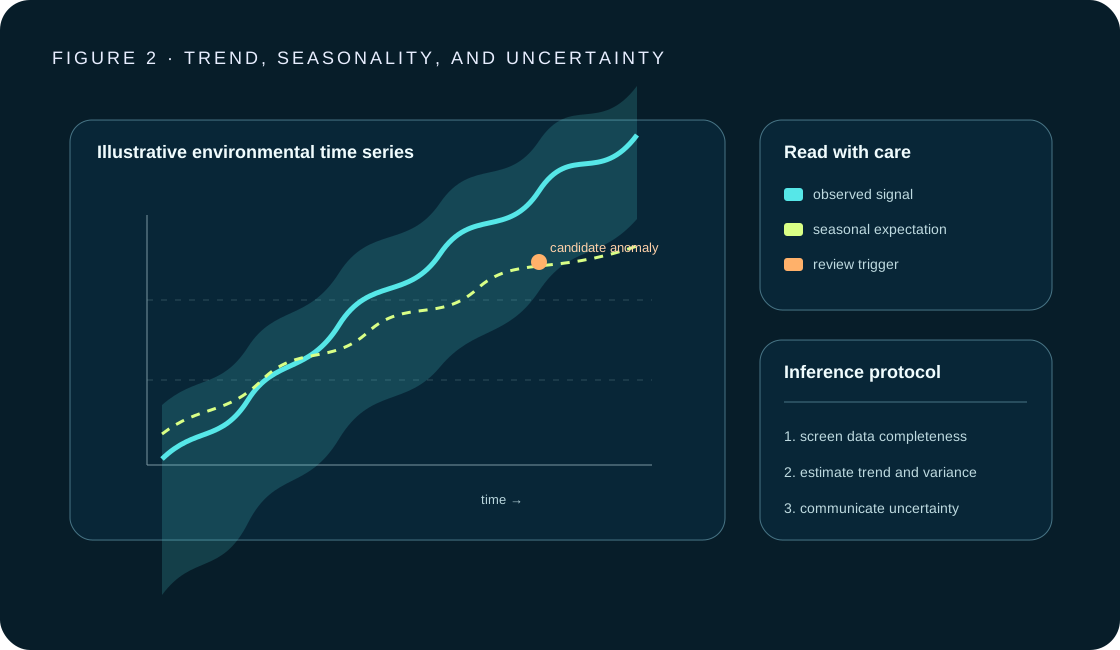
Trend detection should make room for missing observations, sensor differences, changing coverage, and aggregation choices. An anomaly is treated as a review trigger: it directs attention to a period, location, or indicator that deserves contextual investigation.

  • ISeasonality. Compare observed values with expected temporal structure so predictable cyclical movement is not misclassified as unusual change.
  • IIUncertainty band. Show plausible variation around a signal to prevent a thin line from implying false precision.
  • IIICross-source checking. Where possible, compare a candidate pattern against another observation stream or contextual record before communicating it broadly.
Interpretive caution: trends, correlations, and anomalies should not be presented as causal evidence without an explicit causal design and domain review.

Time-series reading protocol

Figure 3 demonstrates the joint presentation of a signal, seasonal comparator, uncertainty envelope, and point for review. The quantity is intentionally generic: the visual structure is the research object.

Environmental time series showing observed signal, seasonal expectation, uncertainty band, and candidate anomaly.
Figure. Environmental time series showing observed signal, seasonal expectation, uncertainty band, and candidate anomaly.
4. Interactive Scientific Communication

Public attention can be
studied, not assumed.

The environmental module treats public communication as an analytical interface. An exhibit or interactive visual should be evaluated by the questions it helps visitors ask, the feedback it elicits, and the design revisions it supports.

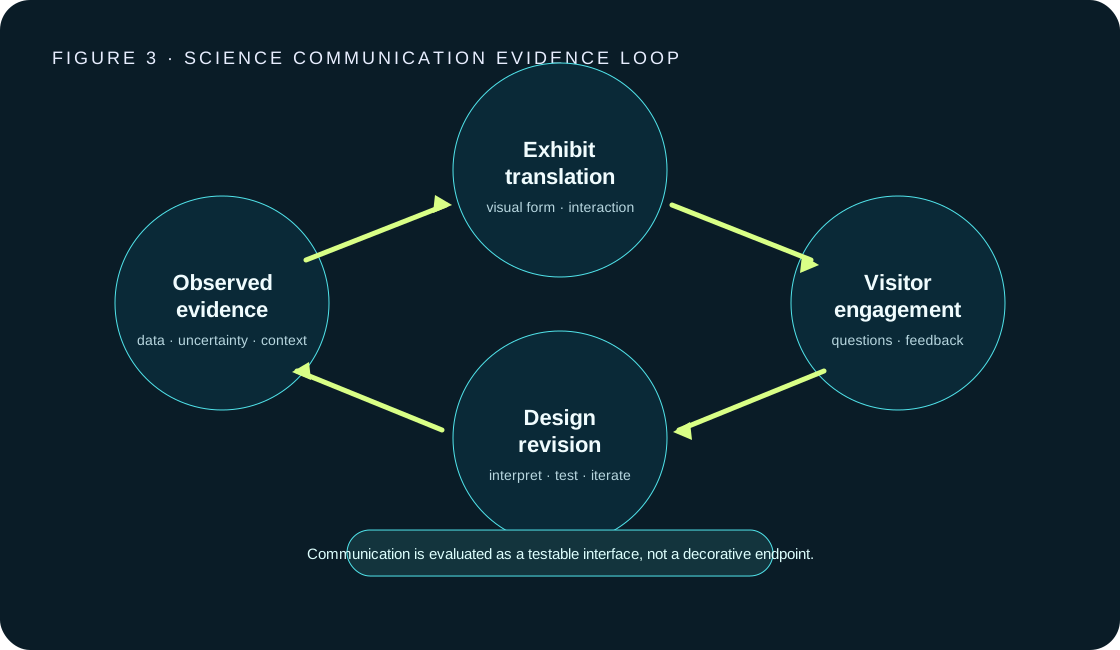
Evidence-to-engagement loop

Figure 4 frames communication as a repeating research loop. Environmental observations are translated into an experience, visitor responses are captured, and the next version is revised with attention to scientific fidelity and public comprehensibility.

Evidence-to-engagement loop from observed evidence through exhibit translation and visitor feedback to design revision.
Figure. Evidence-to-engagement loop from observed evidence through exhibit translation and visitor feedback to design revision.

Evaluation design

Interactive environmental communication can be assessed using mixed evidence: attendance conditions, interaction observations, short feedback instruments, open responses, and pre-defined questions about clarity, interest, and intended follow-up. The aim is to identify where presentation supports or impedes understanding.

  • 01Scientific fidelity. Visual and material choices should preserve key uncertainty, scale, and context from the environmental evidence.
  • 02Interaction quality. Participation is meaningful when it invites observation, comparison, or reflection rather than only novelty.
  • 03Feedback-to-revision. Survey and observational signals inform changes to layout, thematic depth, accessibility, and explanatory language.
Communication principle: a compelling exhibit is not a substitute for scientific methods; it is a structured place where evidence can become discussable.
5. Discussion, Limitations, and Conclusion

Legibility is a scientific
responsibility.

The contribution of this module is methodological. It joins analytical evidence with the conditions necessary for its responsible interpretation and communication.

N

Nature becomes legible when evidence, uncertainty, and communication remain connected. The framework preserves the distinction among data collection, analytical inference, visual translation, and audience response.

The recommended practice is to retain data lineage, modelling or harmonisation decisions, uncertainty statements, visual mappings, and revision rationale as connected research artefacts.

Limitations: the figures and examples on this page are conceptual explanatory material. They do not report validated prediction accuracy, an ecological estimate, or an empirical causal effect. Applied use requires context-specific data governance, validation, and specialist review.

Article components

01

Observation record

Documents source, spatial and temporal coverage, measurement conditions, quality flags, and processing lineage.

DATA
02

Inference layer

Connects harmonised observations with trend, seasonal, anomaly, and uncertainty reasoning.

METHOD
03

Communication evaluation

Relates interactive visual design to feedback evidence and an explicit revision process.

ENGAGE