Research Paper / System 02 · Version 1.0

Large-Sample Feature
Extraction and Visual Analytics.

Abstract— This research system provides a structured workflow for large-sample data preparation, feature construction, correlation-aware screening, dimensionality reduction, interactive visual analysis, and report generation. The design is intended for data-intensive research settings such as industrial inspection and signal analysis, where sample provenance and high-dimensional feature structures must remain interpretable throughout the analysis pipeline. The system combines batch management, configurable feature operators, asynchronous processing, and evidence-oriented reporting to support reproducible analytical studies.

LARGE-SAMPLE ANALYTICSFEATURE ENGINEERINGDIMENSIONALITY REDUCTIONVISUAL ANALYTICS
2,997Documented Source Lines
7Core Functional Modules
4+Supported Research Data Formats
Scope statement: the page documents a research-oriented platform design. The graphics are explanatory; no industrial dataset or diagnostic conclusion is displayed.
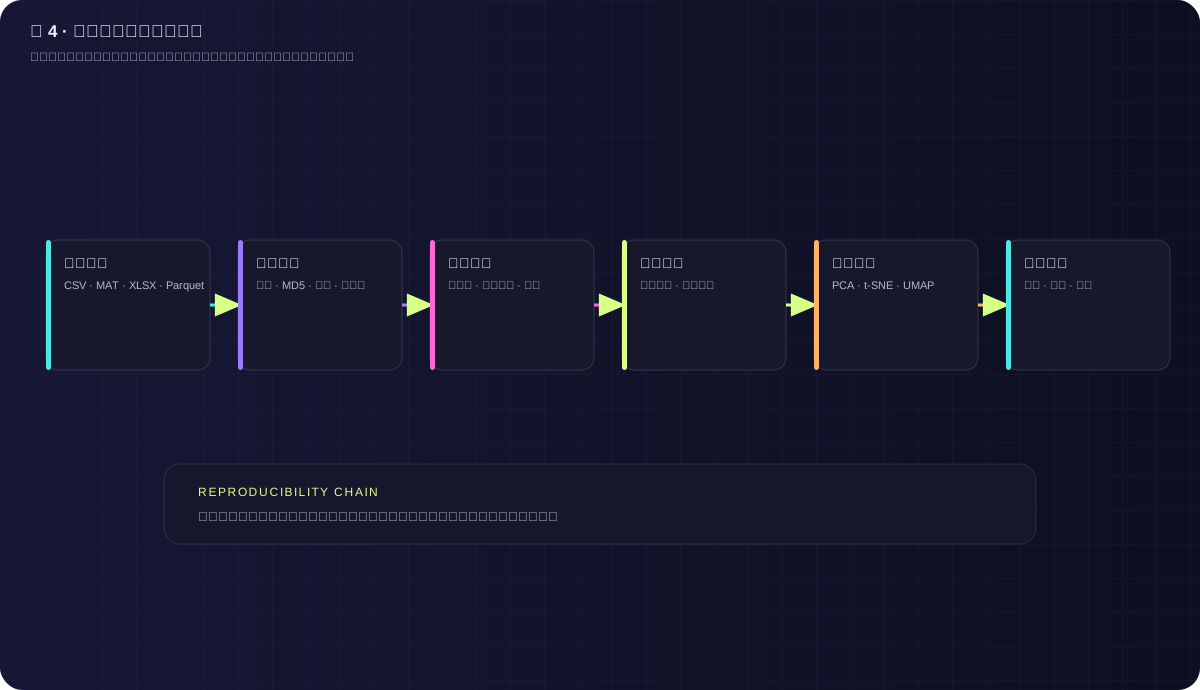
Workflow diagram for large-sample feature extraction and visual analysis
Figure 1Large-Sample Analytical Pipeline
1. Introduction and Data Curation

A feature begins
with its sample history.

Large-sample analysis is vulnerable to hidden differences among collection batches, sensors, preprocessing conditions, and file formats. The first research task is therefore not feature calculation but the establishment of an identifiable and reviewable sample population.

Research problem

High-dimensional analysis can amplify data-quality defects that are difficult to detect after feature generation. A sample-management layer is used to retain batch identity, acquisition context, upload status, and format information so that derived feature matrices remain connected to their source records.

  • 01Batch provenance. Sample collections are grouped by acquisition cycle, equipment source, or research batch, enabling later stratification and comparison.
  • 02Format-aware ingestion. The documented platform accepts common research and industrial formats, including CSV, MAT, XLSX, and Parquet, through controlled batch upload.
  • 03Lifecycle traceability. Source data, preprocessing state, derived features, and reports can be linked through a common batch context.
Methodological principle: feature quality cannot be assessed independently of the population and collection conditions from which the feature is derived.
Data preparation protocol

The design supports an explicit pre-analysis process in which sample metadata, source structure, missingness, anomalous records, and batch boundaries are inspected before high-dimensional transformations are applied. This reduces the risk that downstream clustering or projection visualises artefacts introduced during ingestion.

  • ARegister. Assign each sample set a stable batch identifier and retain essential acquisition and operator metadata.
  • BValidate. Inspect file structure, variable type, dimensional consistency, and basic quality indicators prior to feature processing.
  • CPrepare. Define the preprocessing path and persist the configuration so that identical source inputs can be transformed consistently.
Research boundary: quality checks organise evidence; they do not replace calibration procedures or domain-specific measurement validation.
2. Feature Engineering and Screening

Feature spaces need
controlled construction.

The core contribution is a configurable feature-extraction pipeline in which statistical moments, wavelet-energy descriptors, texture measures, and other operators can be assembled into a documented sequence. The workflow is designed to make feature construction transparent, modular, and comparable across batch conditions.

Feature-space construction

Figure 2 presents a schematic pathway from raw large-sample inputs to a structured feature representation. The illustration indicates the relationship among preprocessing, operator selection, feature tensor construction, and subsequent screening; it does not display measured sample results.

Conceptual diagram of high-dimensional feature-space construction
Figure 2. A conceptual model of how multiple feature operators can transform large-sample inputs into a comparable analytical representation.

Feature engineering protocol

prepare → extract → screen → retain
01

Define the target representation

Select the analytical objective, sampling unit, windowing strategy, and the expected relationship between raw observations and derived features.

DESIGN
02

Compose a feature-operator pipeline

Combine statistical, spectral, temporal, texture, or other operators in a declared order that can be stored and reproduced.

EXTRACT
03

Screen redundant variables

Use correlation-aware filtering to identify highly redundant features and reduce unnecessary dimensional burden before subsequent modelling.

FILTER
04

Persist a feature dataset

Associate the retained representation with the source batch, operator configuration, and run record to enable repeatable comparison.

REGISTER
3. Visual Analytics and Dimensionality Reduction

Projection is a tool
for questioning.

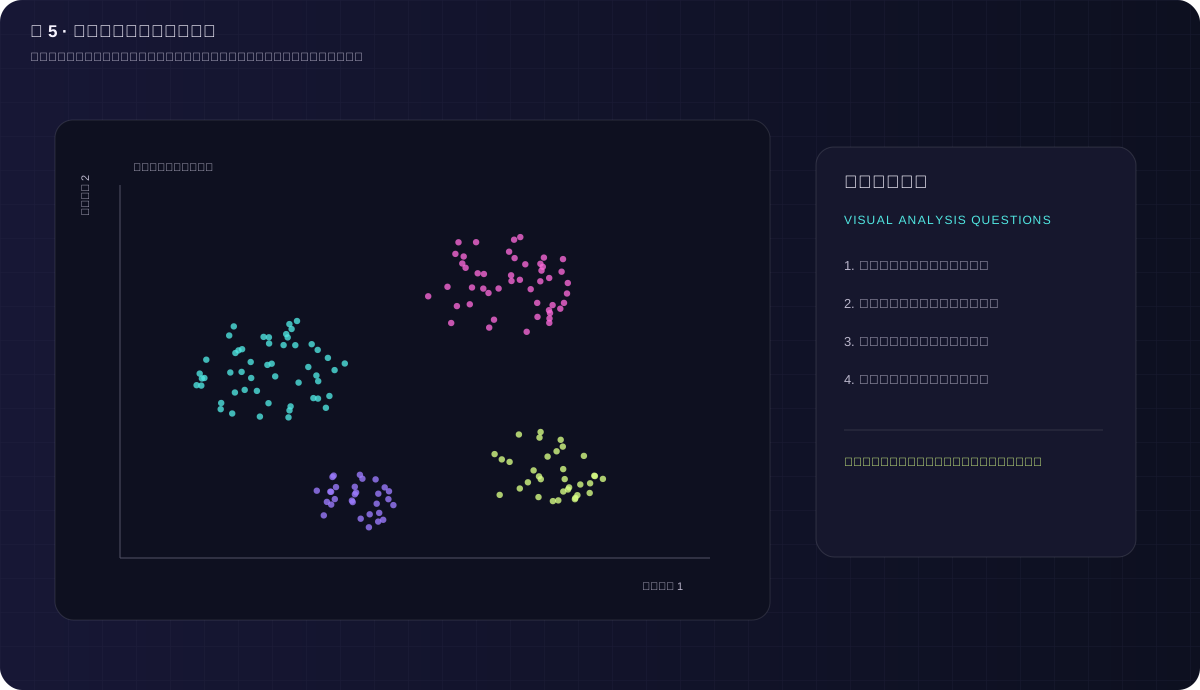
High-dimensional feature matrices are difficult to inspect directly. The platform uses interactive scatter plots, correlation heatmaps, feature-relation networks, and low-dimensional projections to support exploration of clustering, outliers, and candidate associations. These displays are intended to guide investigation, not to substitute for validation.

Analytical interpretation framework

Visual analytical components are organised around the question of whether an observed pattern is stable, batch-specific, or potentially artefactual. Principal Component Analysis, t-SNE, and clustering procedures are described as complementary projection and grouping techniques that can be compared under explicit parameter settings.

  • ICorrelation structure. Heatmaps and association networks support identification of redundant, coupled, or unexpectedly isolated feature groups.
  • IILow-dimensional projection. PCA and nonlinear embedding methods make it possible to inspect broad separation patterns while retaining a link to the underlying feature configuration.
  • IIIInteractive inspection. Zooming, panning, and data-cursor functions allow local patterns to be examined without severing their relationship to the batch and feature context.
Interpretive caution: apparent clusters or separations in a projection are hypotheses for further investigation, not direct proof of diagnostic classes or causal mechanisms.

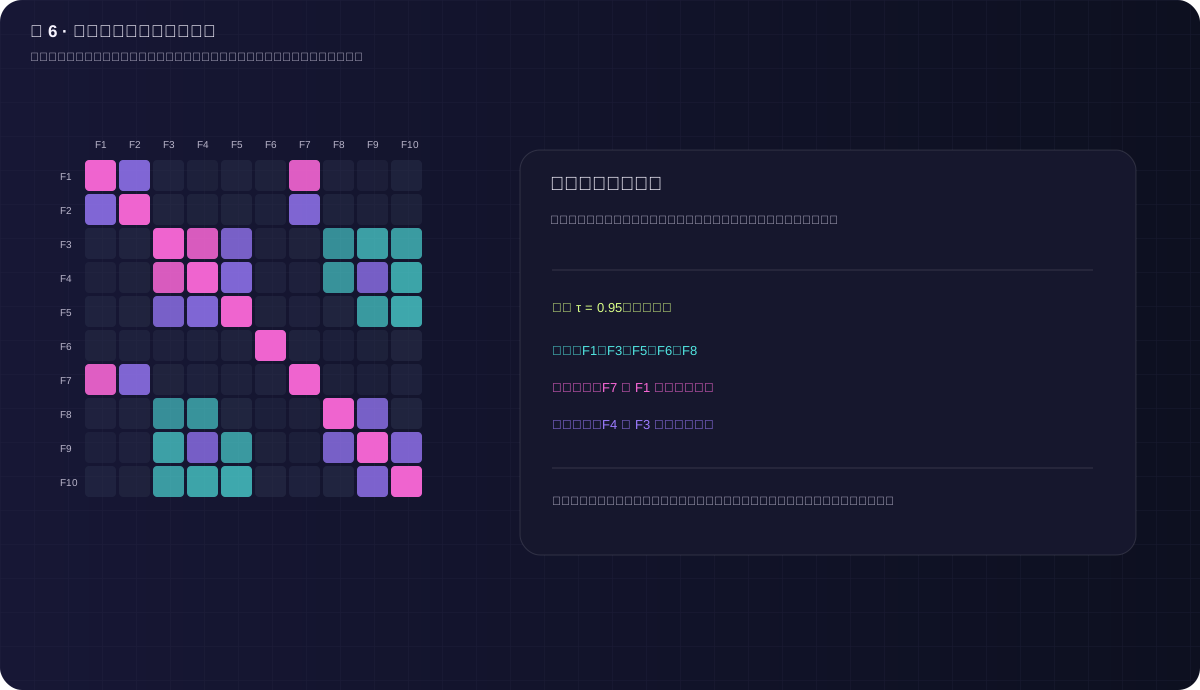
Correlation-aware feature screening

Figure 3 visualises a generic correlation matrix and feature network. It explains how strongly associated variables may be flagged for redundancy review before modelling or reporting.

Schematic feature correlation matrix and association network
Figure 3. A schematic correlation-aware filtering view designed to make feature dependence visible before interpretation.
4. Reporting, Governance, and Reproducibility

An analytical report
is a research record.

The system integrates report generation and administrative controls so that derived figures, parameter choices, batch associations, and report status can be retained as part of a durable research record. Governance is treated as a condition for dependable large-sample analysis rather than as an afterthought.

01

Role-Based Access

Data scientists, analysts, and system administrators can be assigned differentiated page and operation permissions through an RBAC model.

02

Asynchronous Work Queues

Feature-extraction activities can be organised as asynchronous tasks to support large matrix processing without conflating queue state and analytical completion.

03

Parameter Persistence

Operator choices, filtering thresholds, projection settings, and other method controls can be retained with their associated batch and run context.

04

Interactive Figure Records

Scatter plots, heatmaps, and network views can be incorporated into a documented analytical narrative rather than treated as transient dashboard elements.

05

Report Generation

Templates support the assembly of analysis sections, figures, and batch-linked conclusions into standardised report records and export workflows.

06

Audit and Configuration

System parameters, data imports, algorithm invocations, and report operations can be retained for review, operational continuity, and controlled maintenance.

5. Discussion, Limitations, and Conclusion

Insight requires
a chain of evidence.

The research contribution is a workflow-oriented architecture for high-dimensional sample analysis. It connects data ingestion, feature construction, redundancy screening, visual inspection, dimensionality reduction, and reporting to preserve the analytical context in which a pattern was observed.

LS

Features are most useful when their origin, construction, and interpretation remain inspectable together.

Within the proposed workflow, an investigator can revisit an analytical figure through its source batch, preprocessing history, operator pipeline, screening decisions, and report record. This makes it possible to compare alternative pipelines without losing the original analytical condition.

Limitations: the figures are original explanatory diagrams. The page does not report diagnostic accuracy, classification performance, or empirical conclusions from any industrial or scientific dataset. Such claims require separate study design and external validation.

Documented system components referenced by this paper

01

Sample Management and Batch Traceability

Batch upload, format management, source grouping, and lifecycle records establish the research population for subsequent analysis.

DATA
02

Feature Pipeline and Correlation-Aware Screening

Configurable operators and redundancy filtering organise high-dimensional feature construction under explicit methodological controls.

METHOD
03

Visual Analysis, Reduction, and Report Centre

Interactive visualisation, low-dimensional projection, and report generation connect exploratory output with durable research documentation.

ANALYTICS

Documentation basis: feature descriptions, architecture notes, and implementation records supplied for Version 1.0.