Research Paper / System 03 · Version 1.0

Interactive Situation Analysis
and Geometric Representation.

Abstract— This research system frames spatial situation analysis as a traceable process that connects event records, geographic coordinates, geometric annotations, map layers, scenario parameters, and operation logs. The platform is designed for geographic information and emergency-situation research contexts in which dispersed spatial observations must be organised into reviewable analytical evidence. Its central contribution is not autonomous decision-making; instead, it provides a governed infrastructure for spatial data validation, interactive examination, scenario comparison, and retrospective review.

SPATIAL ANALYTICSEVENT WORKFLOWSGEOMETRIC REPRESENTATIONSCENARIO ANALYSIS
2,981Documented Source Lines
5Core Centres plus Overview
4Controlled Event States
Scope statement: this page uses a non-sensitive, generic spatial research narrative. It does not depict real locations, persons, incidents, or operational instructions.
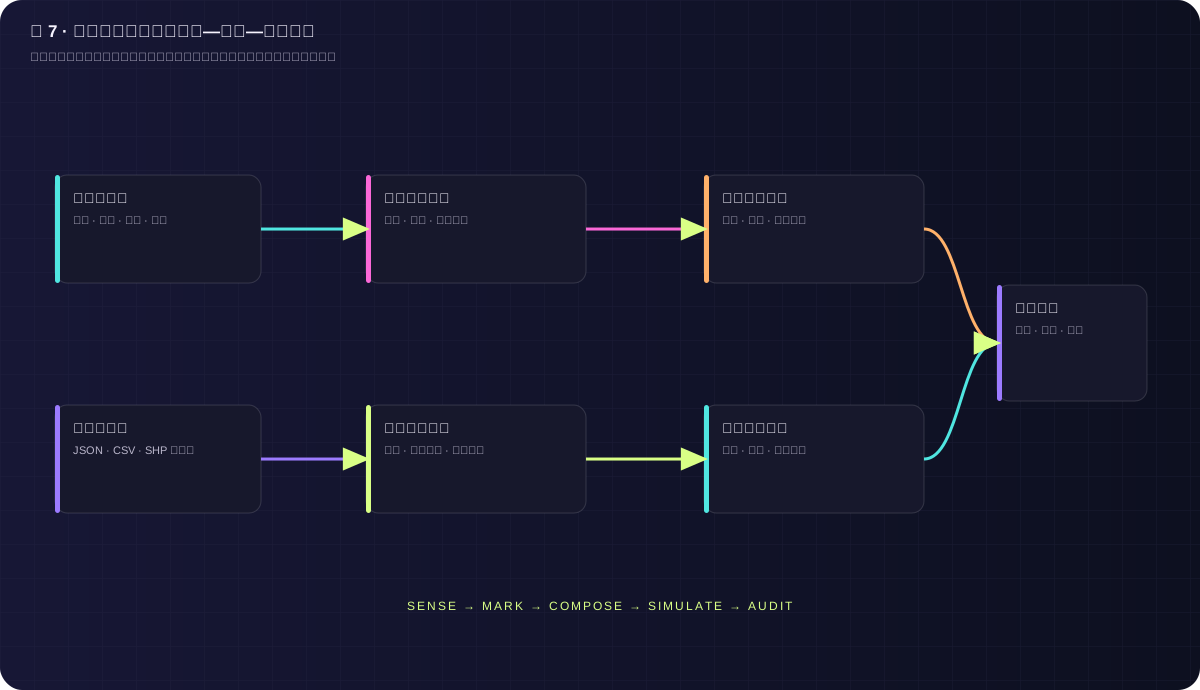
Workflow diagram for spatial event sensing and situation analysis
Figure 1Spatial Evidence Coordination Loop
1. Introduction and Event Sensing

Events acquire meaning
in spatial context.

A spatial event is more than a point on a map. It has a category, a temporal state, a location, an assigned handler, an evidentiary status, and a relation to other layers of information. The system begins by representing these attributes as a managed event object that can support later geometric, temporal, and scenario-based analysis.

Research problem

Situation assessment frequently depends on dispersed observations that arrive at different times and with different degrees of reliability. Without a controlled record structure, it is difficult to determine what was known, when it was entered, where it was located, and how its status changed. The event-sensing component addresses this issue through structured registration, validation, filtering, assignment, and controlled transitions.

  • 01Registration and geolocation. Event titles, categories, regions, and coordinates are captured as structured fields, with coordinate ranges checked before the item enters the workflow.
  • 02State progression. Events move through defined stages—pending verification, marked, under handling, and archived—rather than being treated as ungoverned map annotations.
  • 03Collaborative handling. Events can be assigned and updated while preserving identifiers, operator context, and time stamps for later review.
Research use: the platform supports organisation, comparison, and review of spatial evidence. Substantive decisions must remain with appropriately authorised domain professionals using complete situational information.
Event-analysis protocol

capture → verify → relate → review
01

Capture or import an event record

Register the event source, category, region, coordinates, and initial status, then establish whether the record satisfies minimum structural requirements.

INGEST
02

Verify spatial and attribute validity

Review coordinate ranges, field completeness, and categorical values before the event is displayed or used as a scenario input.

VERIFY
03

Relate the event to map layers

Place the event within a selected spatial reference and connect it to relevant geometric objects, layers, and temporal observations.

RELATE
04

Record handling and review history

Maintain controlled status changes and operation records so that the lifecycle of the event can be reconstructed during retrospective analysis.

REVIEW
2. Geometric Representation and Coordinate Validation

Spatial objects must be
computable and reviewable.

Points, lines, polygons, routes, and designated areas become analytically useful only when they are anchored to an explicit coordinate system and can be managed alongside map layers. The geometric component combines drawing, coordinate transformation, topology-oriented review, and layer controls to establish a structured spatial evidence base.

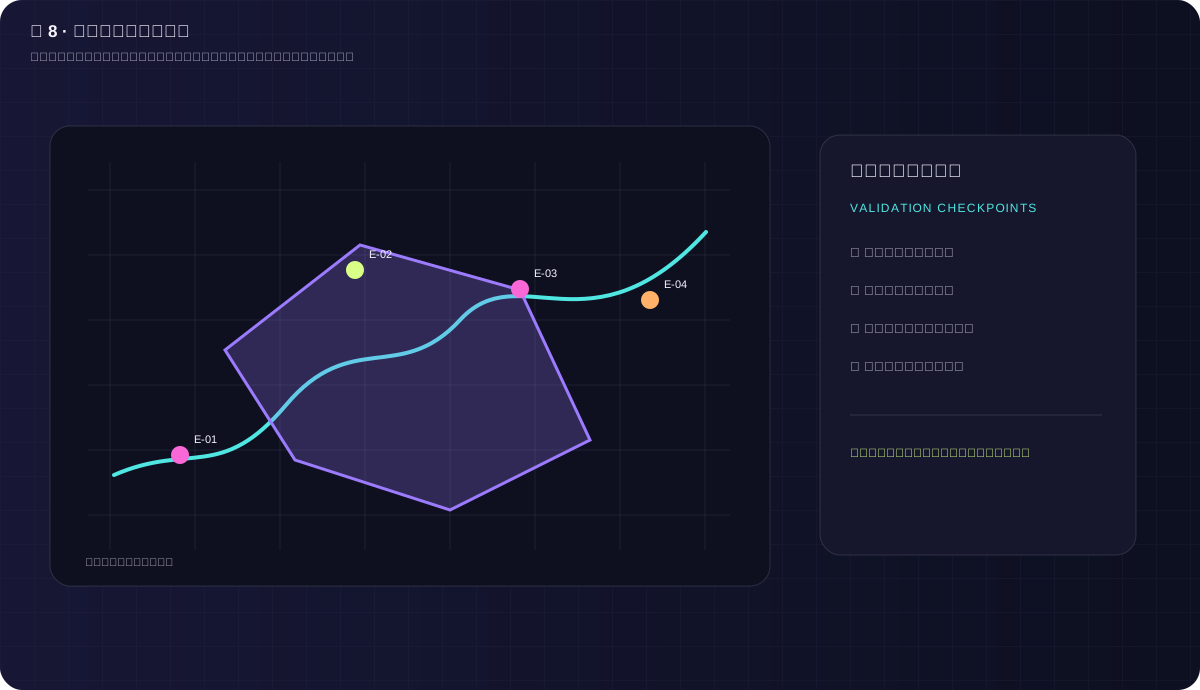
Point, line, polygon, and layer relationships

Figure 2 shows a conceptual map composition in which events, routes, and areas are represented as distinct geometric classes. The diagram illustrates the role of coordinate consistency and layer management in subsequent measurement, overlay, and comparison; it is not a depiction of a real operational area.

Conceptual map diagram of geometric representation and coordinate validation
Figure 2. A schematic geometry-and-layer view demonstrating how spatial objects can be maintained as structured analytical inputs.

Methodological concerns in geometric representation

The geometric workflow is designed around three requirements: spatial consistency, computability, and inspectability. Objects should retain a valid relationship to geographic coordinates; their structure should enable downstream calculations; and their edits should remain recoverable through a record of operations and layer properties.

  • ACoordinate consistency. Coordinate validation and transformation services support the use of a common spatial reference for events and manually created geometry.
  • BTopological usability. The point–line–polygon structure provides a basis for distance measurement, area calculation, overlap review, and spatial queries.
  • CLayer governance. Visibility and opacity controls help prevent uncontrolled accumulation of visual elements and preserve an interpretable map composition.
Interpretive caution: visual prominence on a map should not be interpreted as direct evidence of severity, probability, or causal influence without an independent analytical basis.
3. Interactive Analysis and Scenario Comparison

Compare assumptions
on one timeline.

Scenario analysis is organised as a transparent comparison of explicit assumptions, spatial inputs, time windows, and parameter sets. The design supports distance, area, and terrain-related calculations together with time-indexed replay so that differences among hypothetical configurations can be observed and discussed without being mistaken for autonomous recommendations.

Scenario-analysis protocol

scope → parameterise → replay → compare
01

Define the analysis scope

Identify the spatial boundary, relevant event records, selected layers, and observation interval to prevent unrelated data from being conflated.

SCOPE
02

Declare scenario conditions

Specify the alternate resource, threshold, timing, or spatial parameters that distinguish one scenario from another.

PARAM
03

Replay temporal change

Inspect how events, geometric elements, and layers change across time slices, noting turning points, conflicts, and data gaps.

REPLAY
04

Compare and document

Record the scenario configuration, visual evidence, interpretation notes, publication status, and relevant operation history for later review.

COMPARE

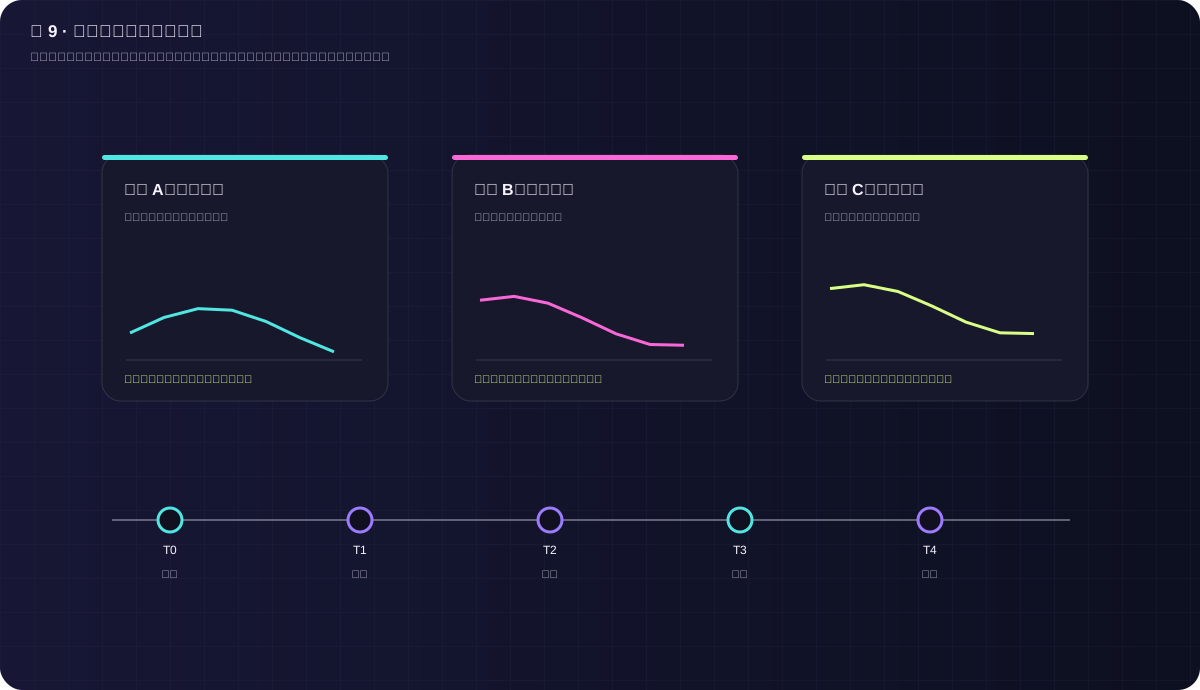
Timeline-based scenario comparison

Figure 3 uses three hypothetical scenario cards and time nodes to demonstrate the comparison principle: differences in observed trajectories should be traced back to distinct input and parameter conditions, then subjected to expert review.

Conceptual timeline diagram for spatial scenario comparison
Figure 3. A non-operational illustration of how a common timeline can support comparison among explicitly documented spatial scenarios.
4. Data Resources, Governance, and Auditability

Spatial evidence must
move under rules.

Spatial research systems handle diverse data objects and must retain a defensible history of access, transformation, and use. The documented design joins data-import workflows, layer management, role-based access, operation logging, and runtime settings to support sustained, governed use.

01

Data Package Ingestion

Structured import supports data-package selection, field mapping, validity checks, and controlled insertion into an analytical environment.

02

Basemap and Layer Control

Basemaps, event layers, geometry layers, and scenario outputs can be managed as distinct layers with selective loading and visual controls.

03

Role-Based Permissions

Administrative, analytical, drawing, scenario, and data-management responsibilities can be separated by role and API access controls.

04

Operation Auditing

Event registration, state changes, assignments, imports, coordinate checks, and scenario publication can be preserved as reviewable operations.

05

Runtime Parameters

Configurable thresholds, refresh intervals, coordinate precision, retention periods, and file limits support maintainable deployment within local governance requirements.

06

Service Coordination

Gateway, geometric service, and resource-service interfaces coordinate authentication, routing, audit functions, coordinate transformations, and data import tasks.

5. Discussion, Limitations, and Conclusion

Maps should expose
evidence chains.

The research contribution is a traceability-oriented spatial workflow linking events, geometry, layers, time, scenarios, and audit records. This structure allows reviewers to inspect what data entered the system, how spatial objects were created, what assumptions were used, and how a scenario or view was produced.

SI

Spatial visualisation should prompt questions about evidence, not compress uncertainty into a single map.

Interactive maps, geometric annotations, and timelines can reduce the cognitive burden of reviewing complex information. They cannot eliminate measurement error, incomplete data, or contextual uncertainty. The proposed design therefore emphasises coordinate validation, controlled state transitions, permission boundaries, and auditable operations as conditions for responsible use.

Limitations: all figures are original, non-sensitive research diagrams. The page contains no real sites, personnel, incident data, tactical procedures, or operational recommendations. The system is a decision-support research framework and is not a substitute for authorised professional processes.

Documented system components referenced by this paper

01

Situation Overview and Event Sensing

Event registration, filtering, location, state tracking, and assignment provide the initial evidence structure for spatial analysis.

SENSE
02

Geometric Representation and Coordinate Services

Point–line–polygon drawing, coordinate transformation, and layer controls provide structured spatial inputs for analysis.

GEOMETRY
03

Scenario Analysis, Data Resources, and Operations

Scenario records, data imports, access controls, audit logging, and parameter management sustain a governed analytical environment.

GOVERN

Documentation basis: feature descriptions, service architecture, and implementation records supplied for Version 1.0.